HDPE Pipe Scraping for Electrofusion: Why Oxide Removal Controls Joint Quality
- Share
- publisher
- Riyang
- Issue Time
- Aug 31,2026
Summary
Scraping the oxidized surface layer off HDPE pipe is the most important preparation step before electrofusion welding. This guide explains what the oxide layer is, why wiping is not enough, how to scrape to the correct length and depth, and how to choose between a manual scraper and a rotary pipe peeler. It also covers avoiding grooves and recontamination, marking insertion depth, and preparing out-of-round pipe.
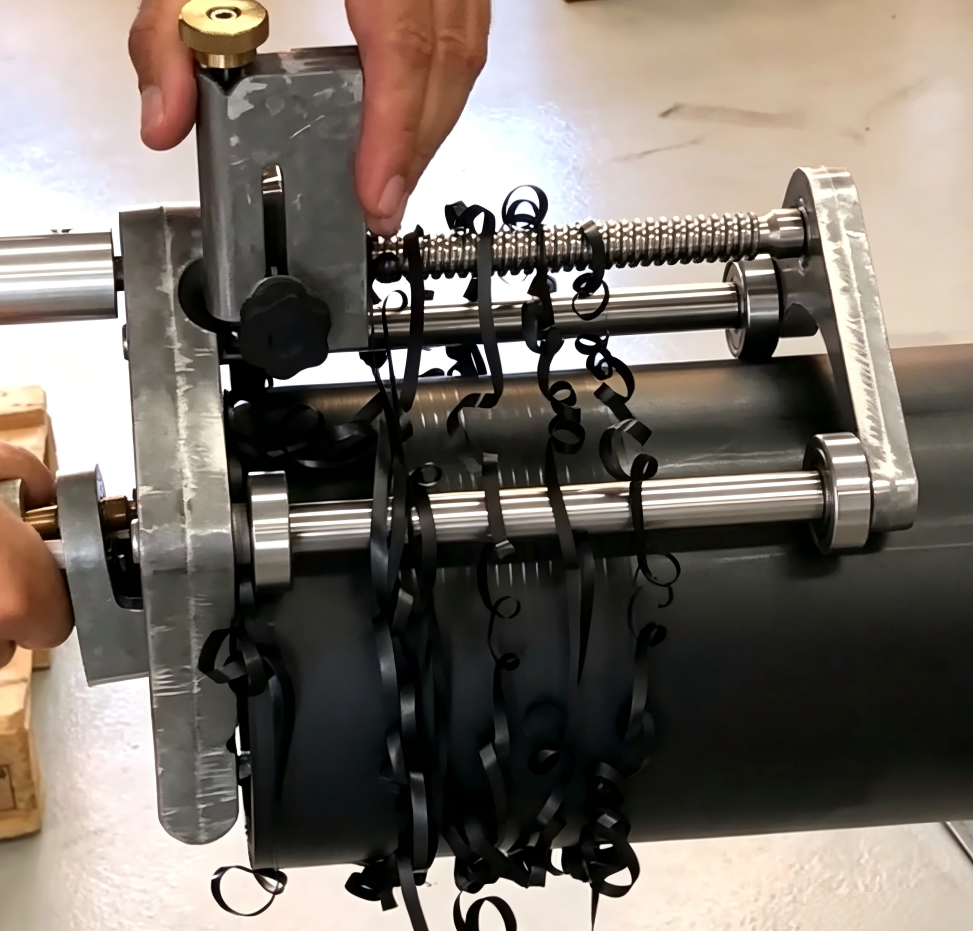
Electrofusion joints bond reliably only when the pipe surface is clean and free of the thin oxidized skin that forms on stored HDPE. Before any electrofusion fitting is assembled, the full fusion zone must be scraped with a purpose-made HDPE pipe scraper or pipe peeler to remove that oxidized layer. Wiping alone leaves the oxide intact, which can compromise joint quality. This guide explains why scraping matters and how to do it correctly. When polyethylene pipe is extruded, its surface is fresh, stable polymer. From the moment it leaves the production line and is stored outdoors or in daylight, the outer surface reacts with oxygen and ultraviolet light. Over time this forms a thin, slightly degraded skin — an oxidized surface layer — on the outside of the pipe. The layer is typically only a fraction of a millimetre thick, but its physical properties differ from the bulk material underneath. That difference is the problem. Electrofusion welding melts the pipe surface and the fitting's embedded heating coil together to form a single, homogenous bond. If an oxidized or degraded skin remains at the interface, it can act as a weak plane between the fitting and the pipe, reducing the reliability of the joint. The oxidized layer, together with any dust, moisture, or release agents trapped on the surface, is therefore removed by mechanical scraping before the joint is made. Cleaning a pipe with a cloth or solvent before electrofusion is good practice, but it is not a substitute for scraping. A solvent wipe can lift loose dirt, grease, and some surface contaminants, but it does not remove the oxidized skin, which is chemically bonded into the pipe surface. The oxide layer must be physically cut away. Think of it as preparing a surface for adhesive bonding: cleaning removes what sits on top of the surface, while scraping removes the top of the surface itself. For electrofusion, the applicable joining standards and fitting manufacturers require mechanical removal of the oxidized layer across the entire fusion zone, not just a cosmetic wipe. Scraping must cover the full circumference of the pipe and the full length that will sit inside the fitting, with a small margin beyond the fitting mouth. A common mistake is scraping only part of the way around, or only the length that is easy to reach, leaving an unscraped ring that sits exactly where the fusion zone is. Depth should be shallow and uniform. Many fitting and tool manufacturers recommend a cut of roughly 0.1 to 0.2 mm — enough to expose clean polymer without removing excessive wall thickness or creating deep grooves. This is a manufacturer recommendation rather than a single universal value, so always follow the specific instructions supplied with the fitting and scraper you are using. Scraping tools fall into two broad families: hand-held manual scrapers and rotary or orbital pipe peelers. Each has a clear place depending on pipe size, access, and production volume. A manual HDPE pipe scraper uses a fixed or adjustable blade that the operator draws around the pipe by hand. It is inexpensive, simple, and works well on smaller diameters where a single pass can cover the circumference. Its main limitation is consistency: depth and coverage depend on the operator's pressure and technique, and long passes are hard to keep uniform. A rotary pipe peeler, also called a mechanical or orbital scraper, clamps around the pipe and rotates a cutting head that shaves the oxide layer as it travels. Because the tool guides the blade at a set depth and follows the pipe's circumference, it produces more uniform coverage with less operator effort — especially valuable on larger diameters and long fusion zones. Blades are commonly tungsten carbide for wear resistance. Three failure modes account for most scraping problems: Before scraping, mark the insertion depth on the pipe so the fitting is pushed home to the correct stop point. The scraped zone must extend slightly beyond this mark, so the entire fusion area — including the end of the fitting mouth — sits on freshly scraped surface. Alignment matters too. An out-of-line pipe can leave one side of the fitting under-stressed and the other over-stressed, and can prevent the fitting from seating to full depth. Support and align the pipe, and use rounding clamps where the pipe is out of round. Correct marking and alignment turn scraping from a surface task into part of a repeatable joint procedure. If pipe has already been scraped, do not assume it is still ready to weld. A scraped surface left exposed for more than a short time can re-oxidize and pick up dust or moisture, undoing the preparation. The safe rule is to re-scrape immediately before assembly if the surface has been exposed or there is any doubt about its condition. Re-scraping is quick and cheap compared with the cost of a failed or questionable joint. Treat any delay between scraping and assembly as a trigger to inspect — and usually to re-scrape — the surface. Match the tool to the pipe diameter and to the condition of the pipe. Mechanical scrapers are typically sold in overlapping diameter bands — for example, classes covering around 50–160 mm, 75–315 mm, and 355–710 mm — so a single tool rarely covers every size on a mixed project. Check the tool's rated range against the largest and smallest pipes you expect to join. For occasional small-diameter joints, a quality manual scraper with fresh blades is often all that is required. It is fast to pick up and simple to control on pipe that is easy to reach. For large-diameter or high-volume electrofusion work, a rotary pipe peeler sized to your range usually pays for itself in speed and consistency, especially on long fusion zones. Ovality changes the calculus: a fixed-depth cutter works well on round pipe but can produce uneven removal on oval pipe. Correct it with a rounding clamp before scraping, then choose a tool that follows the pipe's true shape. Select a Riyang pipe peeler for the required pipe range, or browse the wider pipe welding tools range for complementary preparation equipment. Yes. For electrofusion, the oxidized surface layer must be mechanically removed across the full fusion zone. This is a standard joining requirement, not an optional step. Follow the fitting manufacturer's instructions for the exact procedure. Purpose-made HDPE scrapers and peelers are strongly preferred because they cut at a controlled depth and produce uniform coverage. Improvised tools tend to leave grooves, uneven depth, or missed areas, and can introduce contaminants. Shallow and uniform — many manufacturers recommend around 0.1 to 0.2 mm. This is a manufacturer recommendation, so follow the values supplied with your specific fitting and tool rather than a single fixed figure. As soon as practicable. A scraped surface left exposed can re-oxidize and pick up contamination. If there has been a delay, inspect and re-scrape before assembly. Only the surface that enters the electrofusion fitting needs scraping. The fusion zone is on the outside of the pipe, so focus on the length that will sit inside the fitting. Correct ovality with a rounding clamp before scraping and welding. Out-of-round pipe can cause uneven scraping depth and poor fitting seating.What Is the Oxidized Surface Layer on HDPE Pipe?
Why Wiping Alone Is Not Enough
Scraping Length, Coverage, and Consistent Depth
Manual Scrapers vs Rotary Pipe Peelers
Factor Manual scraper Rotary / orbital pipe peeler Consistency Depends on operator technique Blade guided at set depth, more uniform Small-diameter work Fast and simple Heavier to set up Large-diameter work Slower, harder to keep even Much faster, covers long fusion zones Out-of-round pipe Harder to maintain even depth Better, but still needs a rounding clamp Cost Lower Higher Best fit Small diameters, occasional use Large diameters, production work Avoiding Grooves, Missed Strips, and Recontamination
Marking Insertion Depth and Alignment
Handling Previously Scraped Pipe
Selecting a Scraper by Pipe OD and Ovality
Small diameters
Large diameters & high volume
Out-of-round pipe
Pre-Scraping Preparation Checklist
Frequently Asked Questions
Key Takeaways
References