HDPE Pipe Systems for Aquaculture: Benefits, Applications & Welding Guide
- Share
- Issue Time
- Apr 17,2026
Summary
Learn how HDPE pipe systems improve aquaculture and fish farming operations. Explore key piping systems, benefits, and reliable welding solutions.
1. Introduction
In aquaculture and fish farming, water quality is everything. A stable and clean water system directly affects fish health, growth rate, and overall production efficiency.
However, traditional piping materials often face challenges such as corrosion, leakage, and high maintenance costs. Once a failure occurs, it can interrupt the entire farming operation.
This is why more aquaculture projects are turning to HDPE pipe systems as a reliable and long-term solution.
2. Why HDPE Pipes Are Ideal for Aquaculture Systems
HDPE pipes have become a preferred choice in fish farming due to their durability and stability in demanding environments.
- · Corrosion resistance — Suitable for both freshwater and seawater environments without degradation
- · Leak-free fusion joints — Butt fusion welding creates a fully integrated pipeline, reducing leakage risks
- · Long service life — Designed for long-term use with minimal maintenance
- · Smooth inner surface — Ensures stable water flow and reduces energy consumption
These features make HDPE piping systems especially suitable for continuous-operation environments like aquaculture farms.
3. Key Piping Systems in Aquaculture
Aquaculture projects rely on multiple interconnected piping systems. Each part requires consistent performance and reliable connections.
3.1 Water Supply System
Responsible for delivering clean water into the farming tanks or ponds. Stable flow and contamination-free transport are essential.
3.2 Recirculating Aquaculture System (RAS)
In modern aquaculture, RAS plays a key role in water reuse. It includes filtration, biological treatment, and circulation loops, all of which depend on leak-free piping.
3.3 Drainage and Wastewater System
Used to remove waste, sludge, and wastewater efficiently. Strong and durable pipelines are required to handle continuous discharge.
3.4 Aeration and Oxygen Supply System
Ensures sufficient oxygen levels for fish growth. Reliable piping helps maintain stable air or oxygen delivery.
In all these systems, pipeline integrity directly impacts the stability and efficiency of aquaculture operations.
4. Why Welding Quality Matters in Aquaculture
Aquaculture systems typically run 24/7. Any leakage or pipe failure can lead to water loss, contamination, or even stock loss.
This makes welding quality a critical factor.
A properly welded HDPE system performs as a single, continuous pipeline, ensuring long-term reliability in aquaculture and fish farming environments.
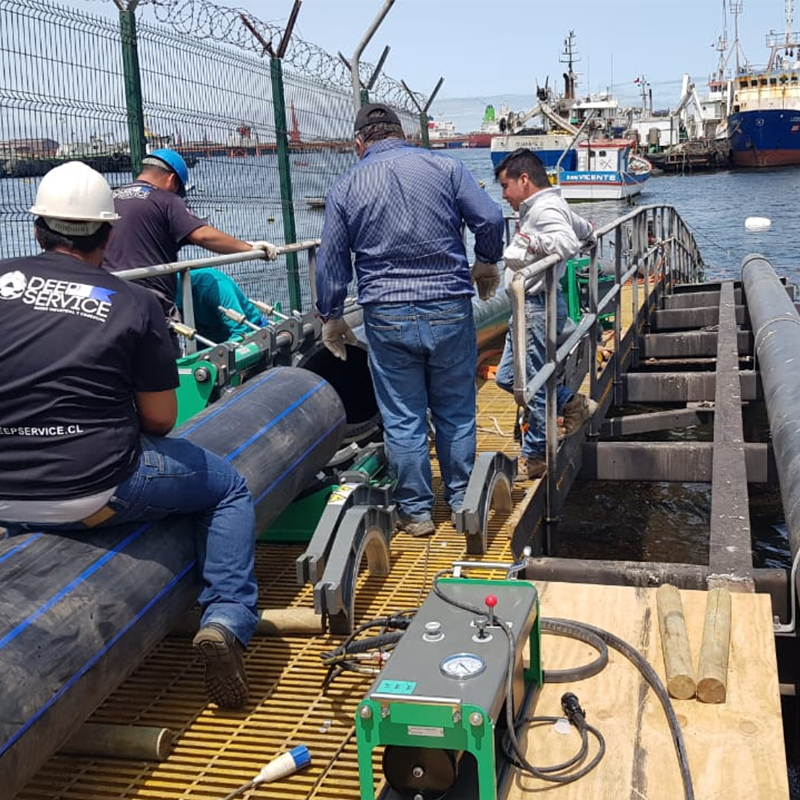
5. Complete Welding Solutions for Aquaculture HDPE Systems
A reliable aquaculture piping system is not built with a single machine, but with a complete set of welding solutions adapted to different installation scenarios.
At Riyang, we provide a full range of HDPE welding equipment to support every stage of aquaculture system construction:
- (1) Butt Fusion Machines
- For main pipeline welding in water supply, circulation, and drainage systems, ensuring leak-free and high-strength joints.
- (2) HDPE Pipe Fitting Machines
- For fabricating elbows, tees, and custom fittings, enabling flexible layouts in multi-pond aquaculture systems.
- (3) Electrofusion Machines
- Ideal for repair work, system upgrades, and installations in confined spaces.
- (4) Socket Fusion Machines
- Designed for small-diameter pipes used in aeration and auxiliary systems.
- (5) Plastic Welding Machines
- Suitable for on-site repair and non-standard plastic welding applications.
- (6) Plastic Sheet Welding Machines
- Used for fabricating HDPE sheet structures such as aquaculture tanks, containment units, and prefabricated systems, supporting high-strength and corrosion-resistant applications.
- (7) Accessories & Data Logging Systems
- Including cutting tools and welding data loggers to ensure precise operation and traceable weld quality.
With the right combination of equipment, aquaculture systems can achieve higher reliability, lower maintenance costs, and longer service life.
6. Conclusion
As aquaculture continues to grow, the demand for stable and efficient infrastructure becomes increasingly important.
HDPE pipe systems, combined with reliable fusion welding technology, provide a practical solution for long-term performance and operational stability.
Choosing the right piping system and welding approach can help reduce risks, improve efficiency, and support sustainable fish farming operations.